


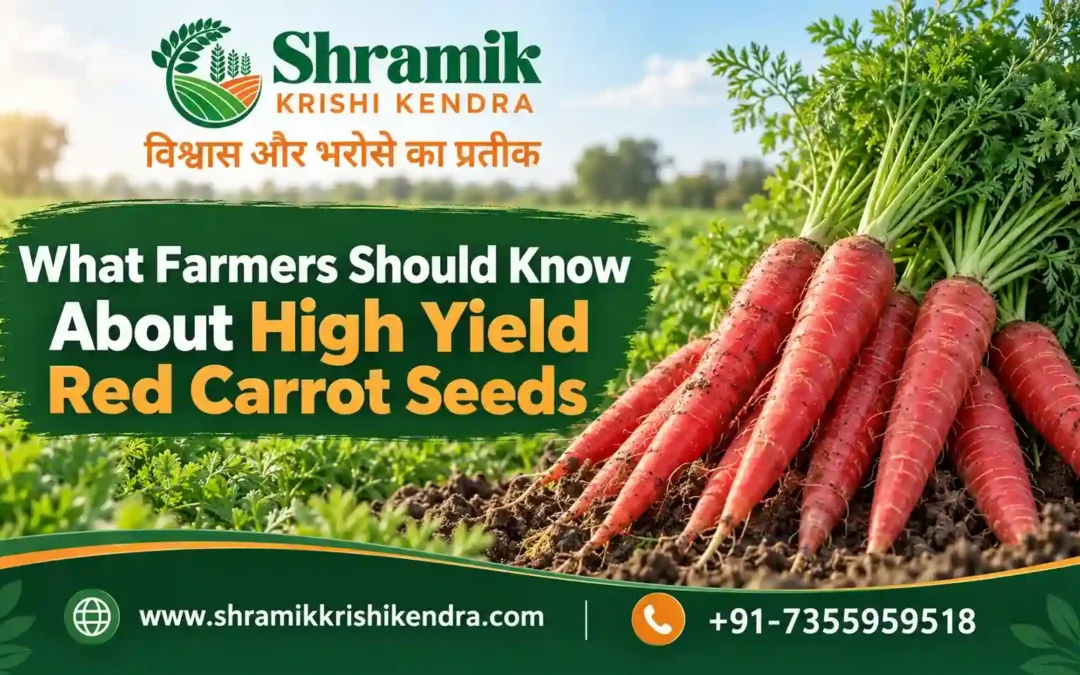
Choosing the right seeds is an important first step in successful carrot cultivation. High Yield Red Carrot Seeds can be considered when farmers are looking for varieties with desirable root characteristics, good crop establishment, and suitable market qualities. However, seed selection alone does not determine yield. Soil preparation, climate, sowing practices, irrigation, nutrition, and timely crop management also influence overall crop performance.
For farmers planning carrot cultivation, understanding these factors before purchasing seeds can help them make more informed decisions and manage the crop according to its requirements.
Why High Yield Red Carrot Seeds Matter in Carrot Farming
Carrot is a cool-season root vegetable that performs well in deep, loose soil where roots can develop without obstruction. According to Tamil Nadu Agricultural University, carrot generally develops good colour when grown around 15°C–20°C and performs well in deep, loose loamy soil with a pH of about 6.0–7.0.
The term high-yield should therefore not be viewed as a guarantee of a particular harvest. Farmers should consider whether the selected variety is suitable for their local climate, soil type, cultivation method, and target market.
What to Check When Selecting High Yield Red Carrot Seeds
Before purchasing seeds, farmers should look at several important characteristics:
1. Variety characteristics:
Different carrot varieties can vary in root shape, colour, size, maturity period, and adaptation. Selecting a variety according to local growing conditions and market demand is important.
2. Seed quality:
Good-quality seed should have reliable germination and be suitable for the intended crop. Seed quality plays an important role in establishing a healthy crop stand. ICAR also highlights quality seed as a critical agricultural input for improving farm productivity.
3. Root characteristics:
For red carrot production, farmers can consider characteristics such as attractive colour, uniform root development, shape, size, sweetness, and market acceptance.
4. Crop duration:
Farmers should check the expected maturity period of the selected variety. This can help with crop planning, irrigation management, labour arrangements, and harvesting schedules.
Soil and Climate Requirements for Red Carrot Seeds
Successful carrot farming begins with suitable soil preparation. Carrots require loose soil that allows the roots to grow downward easily. Heavy, compacted, or poorly prepared soil can interfere with proper root development.
Carrots are generally considered a cool-season crop. TNAU recommends deep, loose loamy soil with a pH range of 6.0–7.0 and notes that good colour development occurs around 15°C–20°C.
Farmers should therefore evaluate soil condition before sowing. Proper field preparation, adequate drainage, and a fine tilth can support better root development.
Sowing and Crop Establishment
Correct sowing practices are important for achieving a uniform crop stand. TNAU guidance for carrot cultivation recommends rows around 25–30 cm apart and describes mixing seed with sand to help distribute small seeds more evenly during sowing.
Farmers should follow the specific sowing rate and spacing recommended for the selected variety rather than applying one standard rate to every seed type.
Adequate soil moisture is also important during establishment. At the same time, excessive moisture and poor drainage should be avoided because they can negatively affect root development.
How to Get Better Results From High Yield Red Carrot Seeds
Using High Yield Red Carrot Seeds is only one part of achieving good crop performance. Farmers should combine quality seed selection with suitable agronomic practices.
Important steps include:
- Prepare a fine, loose seedbed before sowing.
- Select varieties suited to local climate and soil conditions.
- Maintain appropriate row and plant spacing.
- Monitor soil moisture regularly.
- Manage weeds during the early growth stages.
- Provide balanced nutrition based on soil and crop requirements.
- Monitor the crop regularly for pest and disease problems.
- Harvest roots at the appropriate stage for the intended market.
Farmers looking for best carrot seeds should also compare variety characteristics rather than selecting seeds only on the basis of the word “high yield.”
What Farmers Should Know Before Buying Carrot Seeds Online
When purchasing carrot seeds online, farmers should check the product name, variety or hybrid type, pack size, seed quantity, seller information, and available product specifications. It is also useful to understand whether the variety is intended for the farmer’s growing conditions and market requirements.
Farmers planning to buy carrot seeds online can explore the carrot seed collection at Shramik Krishi Kendra, where different carrot seed options are available, including red, hybrid, and improved varieties.
The current carrot category includes products such as Carrot Desi Red Sungro Seeds, Carrot Super Red Mahyco Sungro Seeds, Carrot No. 404 F1 Hybrid, Improved Carrot Aishwarya, Namdhari Super Kuroda, and other varieties.
Understanding Yield Potential
The phrase “high yield” should always be understood in context. Actual production can vary according to variety, soil fertility, temperature, irrigation, sowing method, crop density, pest and disease pressure, and overall management.
An ICAR example involving the Pusa Rudhira carrot variety demonstrated the importance of variety selection and crop management: the reported demonstration produced 393.75 q/ha, with attractive long, deep-red roots and other quality traits contributing to market value. This is a specific field example and should not be treated as a guaranteed yield for every farm.
Therefore, farmers should focus on matching the right seed variety with suitable production practices instead of expecting seed choice alone to deliver a particular yield.
Conclusion
Selecting the right seed is an important foundation for successful red carrot cultivation. High Yield Red Carrot Seeds can be a useful choice when their characteristics match the farmer’s soil, climate, crop duration, and market requirements. However, productive carrot cultivation also depends on proper land preparation, sowing, irrigation, nutrition, weed management, and timely harvesting.
Farmers should compare seed characteristics carefully and choose products from a reliable source. Shramik Krishi Kendra provides different carrot seed options to help farmers explore varieties according to their cultivation needs.