

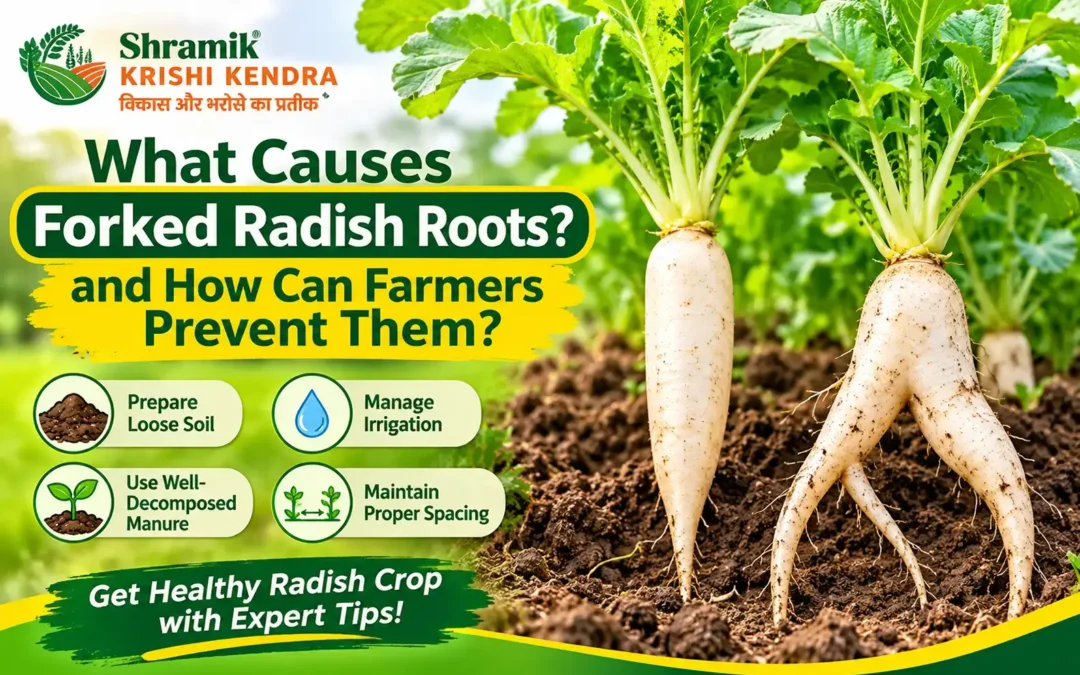
Radish farmers expect straight, uniform roots that meet market quality standards. However, sometimes the main root develops two or more branches instead of growing into a single, well-shaped root. This condition can reduce the crop’s appearance, uniformity and commercial value. Forked radish roots may develop because of compact soil, stones, undecomposed organic matter, root injury, nematode activity and unsuitable growing conditions.
The good news is that farmers can reduce the risk through proper field preparation, suitable seed selection and timely crop management. Understanding the causes helps farmers identify problems early and create better conditions for healthy root development.
What Are Forked Radish Roots?
Root forking, also known as branching or fanging, occurs when the main growing root is damaged or its normal development is disturbed. Instead of forming one straight root, the plant develops secondary roots that create a branched appearance.
This condition is undesirable in commercial radish cultivation because buyers generally prefer roots with a uniform shape, size and appearance.
Forking can have several causes, so farmers should examine the soil, roots and crop history before deciding which corrective measures to take.
Why Do Radish Roots Become Forked?
Several soil-related and crop-management factors can interfere with the development of the main radish root.
1. Compact soil and hard soil clods
Radish roots need loose soil to grow downwards. When the soil is compacted, the main root may face physical resistance. Large clods, stones and hard layers below the surface can also obstruct root development.
This problem can be more noticeable in heavy soils that have not been prepared properly.
What farmers should do:
- Loosen the soil before sowing.
- Break large soil clods into smaller particles.
- Remove stones and other physical obstructions from the seedbed.
- Prepare sufficient soil depth according to the selected radish variety.
- Improve drainage where the soil tends to retain excess water.
A deep, loose and well-prepared seedbed gives developing roots more space to grow.
2. Fresh or undecomposed farmyard manure
Fresh manure and undecomposed organic matter can interfere with normal root development. They may stimulate excessive root branching, particularly when placed close to developing roots.
Organic matter is beneficial for soil health, but it should be properly decomposed before application.
What farmers should do:
- Use well-rotted farmyard manure or mature compost.
- Avoid placing fresh manure directly in the root zone.
- Mix organic matter evenly into the soil during field preparation.
- Follow locally recommended nutrient-management practices.
Using mature organic matter helps improve soil structure without exposing young roots to undecomposed material.
3. Damage to the main root during early growth
The main root tip is important for the development of a straight radish root. If this growing point gets injured during early growth, secondary roots may develop and produce a branched shape.
Damage can occur because of rough intercultural operations, physical obstructions, soil pests or other root disturbances.
What farmers should do:
- Prefer direct sowing in a properly prepared field.
- Avoid unnecessary disturbance around young plants.
- Carry out weeding carefully and avoid deep hoeing close to crop rows.
- Inspect affected plants to identify possible root damage.
- Use appropriate pest-management practices after confirming the cause.
Protecting the young root system is important because early damage can affect the final shape of the harvested radish.
4. Root-knot nematode infestation
Root-knot nematodes are soil-inhabiting pests that attack plant roots. Their feeding activity can damage the growing root tip and lead to distorted, stunted or branched roots.
Farmers should look for additional signs, such as small swellings or galls on the roots, uneven crop growth, yellowing and patches of stunted plants.
What farmers should do:
- Inspect roots from affected plants for unusual swellings or galls.
- Avoid repeatedly planting susceptible crops in heavily infested fields.
- Use suitable crop rotation and field sanitation practices.
- Obtain a soil or root sample diagnosis when nematode infestation is suspected.
- Follow locally recommended integrated nematode-management practices.
Do not assume that every deformed radish is affected by nematodes. Soil compaction, root injury and other growing conditions can produce similar symptoms.
5. Excessive soil moisture and unsuitable drainage
Soil moisture affects root development throughout the crop cycle. Excessive moisture, particularly in heavy or poorly drained soil, can create unfavourable conditions around developing roots.
Radish needs adequate moisture, but water should not remain stagnant around the root zone.
What farmers should do:
- Prepare fields with suitable drainage.
- Avoid unnecessary irrigation when the soil is already sufficiently moist.
- Consider raised beds where waterlogging is a recurring problem.
- Check soil moisture regularly, especially after rainfall.
- Adjust irrigation according to soil type, crop stage and local weather.
The aim is to maintain suitable moisture without keeping the soil waterlogged.
6. Poor-quality or low-vigour seeds
Seed quality also influences early crop establishment. Old or low-vigour seeds may produce weak or irregular seedlings, which can affect uniform crop development.
Poor germination can also result in uneven plant populations and additional crop-management challenges.
What farmers should do:
- Purchase seeds from reliable sources.
- Check the seed packet’s lot number, packing details and validity information.
- Follow the recommended storage conditions.
- Use varieties suitable for local growing conditions.
- Follow the seed company’s sowing and crop-management instructions.
Good seed quality supports uniform establishment, but it cannot compensate for poor soil preparation or unsuitable field conditions.
Which Soil Conditions Affect Radish Root Shape?
Soil structure is one of the most important factors influencing root development. A loose, deep and well-drained growing medium allows the main root to penetrate the soil with fewer obstructions.
The following table summarises common conditions that farmers should check before sowing.
| Soil or field condition | Possible effect | Recommended management |
|---|---|---|
| Compact soil | Restricts root penetration | Loosen the soil before sowing |
| Stones and hard clods | Obstruct or deflect developing roots | Remove physical obstacles |
| Shallow soil preparation | Limits space for root development | Prepare suitable soil depth |
| Fresh organic manure | Can encourage irregular root branching | Use well-decomposed manure |
| Poor drainage | Creates unfavourable root-zone conditions | Improve field drainage |
| Nematode-infested soil | Can damage growing root tips | Diagnose and manage infestation |
Sandy loam soil with good structure and drainage is suitable for many radish varieties. However, the ideal soil depth depends on the variety’s root length and shape. Long-rooted varieties generally need deeper, more thoroughly prepared soil than short or round-rooted varieties.
How Can Farmers Prevent Forked Radish Roots?
Preventing root deformities starts with proper crop management before sowing. Farmers should focus on soil preparation, suitable spacing, balanced irrigation and timely harvesting to support healthy root development. For more practical guidance on these practices, read our detailed guide on radish crop management.
1. Prepare the field properly before sowing
Start by loosening the soil and breaking large clods. Remove stones and other obstacles that may interfere with root growth. Make sure the prepared soil provides enough depth for the selected variety.
Avoid cultivating when the soil is excessively wet, as this can contribute to compaction.
2. Apply well-decomposed organic manure
Use mature compost or well-rotted farmyard manure during field preparation. Avoid fresh manure immediately before sowing, particularly near the seed and developing root zone.
Apply fertilisers according to soil conditions and recommended nutrient requirements. Excessive or poorly placed fertiliser can also injure developing roots.
3. Maintain recommended plant spacing
Overcrowding can increase competition among plants for light, moisture and nutrients. It may also result in uneven root development and make field operations difficult.
Follow the recommended row-to-row and plant-to-plant spacing for the selected variety. Do not use one spacing measurement for every radish type, because root size and growth habits differ.
4. Manage irrigation according to soil conditions
Maintain reasonably consistent soil moisture during root development. Avoid prolonged dryness as well as excessive irrigation.
It is also important to understand the difference between forking and cracking. Uneven moisture, especially a sudden increase in water availability after a dry period, is commonly associated with root cracking or splitting. It should not automatically be treated as the cause of every forked root.
5. Protect young roots from injury
Avoid deep hoeing or unnecessary cultivation close to the crop rows. Remove weeds carefully and inspect plants when root deformation is noticed.
If several plants show unusual branching, examine the roots and surrounding soil to identify whether the problem is physical damage, soil conditions or a possible pest infestation.
6. Harvest at the recommended maturity stage
Harvest radish according to the maturity guidance for the selected variety. Leaving roots in the field beyond the recommended stage can reduce quality and increase the likelihood of other physiological problems, including pithiness or cracking in some varieties.
Check the crop regularly rather than relying on a fixed harvesting period for every variety.
Are Forked Radish Roots and Cracked Radish Roots the Same?
No. Forking and cracking are two different root-development problems.
Forking occurs when the main root develops secondary branches, giving it a divided or multi-pronged appearance. It is often associated with root-tip injury, compact soil, physical obstructions, undecomposed organic matter and nematode damage.
Cracking or splitting occurs when the root develops a visible split or opening. It is commonly associated with irregular moisture availability, rapid root expansion and roots remaining in the field beyond their ideal harvest stage.
| Feature | Forking | Cracking or splitting |
|---|---|---|
| Appearance | Root divides into branches | Root develops a crack or split |
| Common contributing factors | Root injury, compact soil, obstructions and undecomposed manure | Uneven moisture and rapid expansion |
| Main management focus | Protect the main root and improve soil conditions | Maintain suitable moisture and harvest at the right stage |
Correctly identifying the problem helps farmers choose suitable management practices instead of applying the wrong solution.
Does Radish Variety Selection Matter?
Yes. Different radish varieties have different root shapes, lengths, sizes and maturity periods. Their soil-depth and crop-management requirements may also differ.
For example, a long-rooted variety generally needs deeper and looser soil than a short or round-rooted variety. Selecting a variety without considering the field’s soil conditions may create challenges during root development.
Before purchasing seeds, farmers should consider:
- Expected root shape and size.
- Suitability for the local climate and growing season.
- Soil type and field drainage.
- Recommended sowing depth and spacing.
- Expected maturity period.
- Seed quality and information provided by the manufacturer.
Farmers can explore the radish seed range at Shramik Krishi Kendra and review available product details before selecting seeds for their cultivation requirements.
Conclusion
Producing straight, uniform radish roots requires proper soil preparation, healthy seed selection and careful crop management. Compact soil, stones, undecomposed manure, root injury and nematode infestation can interfere with normal root development and contribute to branching.
To reduce the risk of Forked radish roots, farmers should prepare a loose and well-drained seedbed, use decomposed organic manure, maintain variety-specific spacing, protect young roots and harvest at the recommended stage. They should also inspect affected plants to identify the actual cause rather than assuming that every malformed root has the same problem.
With suitable field preparation and timely crop care, farmers can improve root uniformity and the market quality of their radish harvest. Shramik Krishi Kendra offers agricultural seeds and farming products to help farmers make informed crop-input choices.