

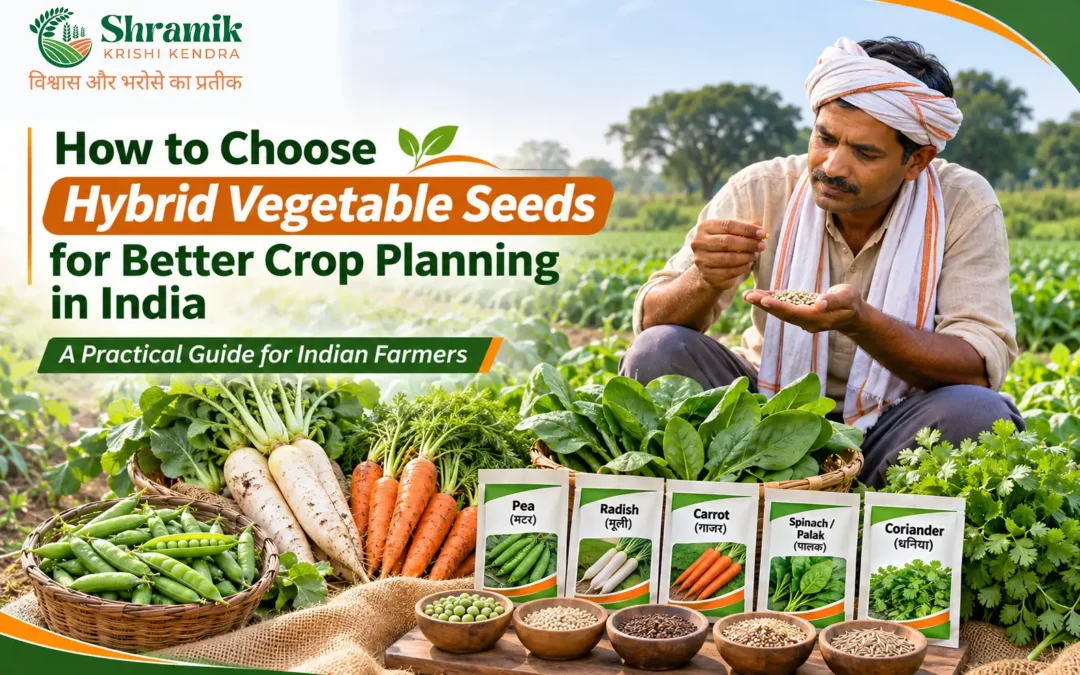
Choosing the right vegetable seeds is one of the most important decisions farmers make before starting a new crop. Whether you are growing tomatoes, brinjal, chilli, cucumber, peas, or other vegetables, your seed selection can influence crop development, harvesting schedules, produce quality, and overall cultivation costs.
With so many seed brands and hybrid varieties available in India, selecting suitable seeds involves more than comparing prices or choosing a familiar brand.
Farmers need to consider the local climate, sowing season, soil conditions, irrigation availability, and the characteristics of each variety.
The best hybrid vegetable seeds are not necessarily the most expensive or most popular ones. They are the varieties that match your growing conditions, crop requirements, and market expectations.
This guide explains how to choose hybrid vegetable seeds in India, what to check before buying seeds online, and how informed seed selection can support better crop planning.
What Are Hybrid Vegetable Seeds?
Hybrid vegetable seeds are produced through controlled crossing between selected parent lines to combine specific characteristics in the first generation, commonly known as F1.
Depending on the crop and variety, these characteristics may include:
- Plant vigour and growth habits
- Fruit size, shape, and colour
- Uniformity of produce
- Maturity period
- Marketable produce quality
- Resistance to certain diseases, where specifically developed and documented
However, hybrid seeds do not guarantee higher yields or better performance under every farming condition. Their results depend on factors such as temperature, soil, water availability, crop management, and pest pressure.
Hybrid seeds also differ from open-pollinated varieties. Seeds saved from an F1 hybrid crop may produce plants with different characteristics in the next generation.
To understand these differences, read our detailed guide on Hybrid vs. Open-Pollinated Vegetable Seeds.
1. Choose Seeds According to the Growing Season
Before purchasing any vegetable seeds, check whether the selected variety is suitable for your intended sowing season.
India experiences different climatic conditions across regions. A crop that performs well during one season in northern India may require a different planting schedule in southern or warmer regions.
For example, many farmers in northern India grow cool-season vegetables such as peas, radishes, carrots, spinach, and coriander during the Rabi season.
Warm-season vegetables such as watermelon and cucumber generally require suitable temperatures and careful seasonal planning.
When choosing seeds, consider the following questions:
- Is the variety suitable for the expected temperature range?
- Does it require direct sowing or nursery preparation?
- Is the recommended planting period suitable for your location?
- Will irrigation be available during important crop growth stages?
- Does the expected harvest period match your market requirements?
Farmers planning winter cultivation can explore our Best Vegetable Seeds to Sow in November in India guide for practical Rabi season information.
Remember that local weather and crop requirements are more important than following a general sowing calendar without considering regional conditions.
2. Compare Hybrid Seed Varieties Before Buying
Different hybrids of the same vegetable can produce different results depending on their genetics and growing conditions.
For this reason, selecting seeds based only on the brand name or price may not be the best approach.
Instead, compare varieties according to the characteristics important for your cultivation plans.
| Vegetable Crop | Important Characteristics to Compare |
|---|---|
| Tomato | Fruit size, firmness, colour, maturity, and stated disease resistance |
| Brinjal | Fruit shape, colour, weight, plant habit, and harvesting period |
| Chilli | Fruit length, pungency, colour, maturity, and plant characteristics |
| Cucumber | Fruit size, shape, skin colour, texture, and maturity |
| Peas | Pod characteristics, crop duration, and seasonal suitability |
| Radish | Root shape, length, colour, maturity, and growing conditions |
Example: Choosing Hybrid Brinjal Seeds
Suppose you want to grow brinjal for a market where round, purple fruits are preferred.
In that situation, selecting a variety with the appropriate fruit characteristics may be more useful than choosing a seed solely because of its popularity.
For example, Sungro F1 Hybrid Brinjal Seeds are listed with bright-purple, round fruits and a 2,000-seed pack.
These product details help farmers assess whether the variety matches their requirements.
However, growers should also confirm the recommended planting season, growing conditions, and other manufacturer specifications before purchasing.
A suitable variety is one that meets both your farming requirements and your customers’ produce preferences.
3. Check Seed Quality and Packet Information
Seed quality is an important consideration when buying hybrid vegetable seeds online.
A properly labelled packet can provide information about the variety, seed quantity, batch identification, germination, and handling instructions.
Before purchasing, carefully review the product information and available packet images.
Variety Name and Brand
Confirm the exact crop, variety name, and brand or manufacturer.
Different varieties may have similar names, so checking the product details helps avoid ordering the wrong seeds.
Batch Number and Relevant Dates
Check the batch or lot number along with the applicable packing, testing, and validity information.
These details support product identification and traceability.
Germination and Purity Details
Review the germination and purity information provided on the seed label, where applicable.
Remember that laboratory germination results do not guarantee identical emergence under all field conditions.
Seed Treatment Information
Some commercial seeds are supplied with protective treatments.
Always follow the instructions printed on the seed packet. Treated seeds should never be used for food or animal feed.
Pack Size
Seed packets may be sold by number of seeds or weight.
Check the quantity carefully before ordering, especially when comparing products from different brands.
Buying seeds online becomes easier when the product listing provides clear, accurate, and complete information.
4. Match Your Seeds With Soil Conditions
Even good-quality seeds require suitable soil conditions for successful crop establishment.
Before finalising a hybrid seed variety, consider the type of soil in your field and how well it supports the intended crop.
Soil Structure
Different crops have different root systems.
Root vegetables such as radishes and carrots generally perform better in appropriately prepared soil that allows the roots to develop without excessive obstruction.
Compacted soil, stones, or large clods may interfere with root development.
For more information, explore our Radish Crop Management Guide.
Drainage
Poor drainage and prolonged waterlogging can affect root health and crop development.
Farmers should assess field drainage before sowing and take appropriate measures where excess water is a concern.
Organic Matter
Well-decomposed compost and other suitable organic amendments can improve soil properties.
However, nutrient management should be based on crop requirements and soil-test results wherever practical.
Irrigation Availability
Different vegetables require different irrigation schedules.
Selecting a variety without considering water availability can create problems during important crop growth stages.
Before purchasing seeds, make sure the crop’s water requirements can be managed under your farming conditions.
5. Understand the Crop Maturity Period
The maturity period helps farmers plan sowing, transplanting, harvesting, labour, and marketing activities.
However, seed descriptions may express maturity in different ways.
Some varieties are described in terms of days after sowing, while others are measured in days after transplanting.
These measurements are not the same.
For example, if a brinjal variety is described as reaching maturity approximately 60–65 days after transplanting, this does not mean it will necessarily be ready 60–65 days after the seeds were sown.
Actual maturity also varies according to growing conditions.
When comparing seeds, consider:
- The starting point used for the stated maturity period
- Your expected planting date
- Local temperature conditions
- The intended harvesting schedule
- Market demand during the expected harvest period
Understanding these details helps farmers organise their cultivation plans more effectively.
6. Calculate How Many Seeds You Need
Purchasing the correct quantity of seed is important for controlling cultivation costs.
Buying too little can interrupt planting, while purchasing unnecessary quantities may increase expenses and create storage challenges.
Seed requirements depend on several factors, including:
- Total cultivation area
- Crop-specific plant spacing
- Direct sowing or transplanting method
- Expected plant population
- Seed germination and establishment conditions
- Seed quantity available in each packet
For transplanted vegetables, farmers should estimate the number of nursery plants needed for the intended field area.
Additional seedlings may be required to replace plants that do not establish successfully.
For directly sown crops, the seed requirement will depend on recommended sowing practices and the number of seeds planted per position.
There is no universal seed rate that applies to every vegetable.
Always refer to appropriate crop-specific recommendations when calculating seed requirements.
7. Consider Market Demand Before Selecting a Variety
Successful crop planning involves more than producing vegetables.
Farmers also need to consider whether buyers prefer the fruit size, shape, colour, and other characteristics of a particular variety.
For example:
- Some markets prefer round brinjal, while others favour long varieties.
- Tomato buyers may have preferences for size, firmness, and colour.
- Chilli demand can vary according to pungency, length, and appearance.
- Different cucumber types may suit different local or wholesale markets.
- Pea buyers may look for particular pod characteristics.
Understanding local market demand can help farmers choose varieties that better match buyer expectations.
Farmers supplying wholesale markets may also need to consider produce handling and transportation requirements.
Before placing a large seed order, it is useful to discuss product preferences with regular traders, buyers, or local markets.
8. Compare Total Cultivation Costs, Not Just Seed Prices
When buying hybrid vegetable seeds, the lowest packet price does not always mean the lowest overall cultivation cost.
Similarly, an expensive hybrid does not automatically guarantee higher profitability.
Farmers should consider the complete cost of growing a crop, including:
- Seeds and nursery preparation
- Field preparation
- Organic amendments and fertilisers
- Irrigation
- Labour
- Crop protection
- Harvesting
- Packaging and transportation
A suitable seed variety should fit the expected cultivation budget and intended production goals.
Instead of choosing seeds based on exaggerated yield or profit claims, compare the variety’s verified characteristics with your local farming experience.
The goal should be informed crop planning, not simply purchasing the cheapest or most expensive seeds.
9. Avoid These Common Mistakes When Buying Vegetable Seeds Online
Online agricultural stores provide convenient access to different seed varieties, but farmers should still make informed purchasing decisions.
Choosing Seeds Only by Brand Popularity
A well-known brand may offer several varieties, but not every variety is suitable for every crop, season, or location.
Ignoring the Sowing Season
Planting an unsuitable variety during unfavourable weather may affect crop establishment and development.
Overlooking Seed Packet Details
Important information such as pack size, batch identification, validity information, and seed treatment should not be ignored.
Assuming Every Hybrid Is Disease-Resistant
Disease resistance differs by crop and variety.
Only rely on resistance information when it is specifically stated and supported by the product or manufacturer.
Buying More Seeds Than Required
Excess seed purchases may increase costs and create storage problems.
Expecting Guaranteed Yields
Seed performance depends on many factors, including weather, soil, water, nutrition, pests, diseases, and management practices.
No seed variety can guarantee a particular yield under every growing condition.
10. Hybrid Vegetable Seed Buying Checklist for Indian Farmers
Before purchasing hybrid vegetable seeds online, use this practical checklist.
| Check Before Buying | Why It Matters |
|---|---|
| Crop and variety name | Helps confirm the correct seed selection |
| Growing season | Helps match the crop with suitable weather |
| Local climate | Supports variety suitability |
| Fruit characteristics | Helps meet market preferences |
| Maturity period | Supports harvesting and marketing plans |
| Pack size | Helps estimate purchasing requirements |
| Seed label information | Supports quality assessment and traceability |
| Disease resistance details | Helps identify verified variety-specific characteristics |
| Seller information | Supports informed buying decisions |
Keeping a record of the varieties planted each season can also be useful.
Farmers can compare establishment, crop growth, harvest timing, and produce quality to make better decisions in future seasons.
Where to Buy Hybrid Vegetable Seeds Online in India
Farmers looking to buy hybrid vegetable seeds online should choose varieties based on their crop requirements, local growing conditions, and the specifications provided by the seller or manufacturer.
At Shramik Krishi Kendra, farmers and growers can explore a selection of vegetable seeds and agricultural products for different cultivation needs.
Whether you are planning tomato, chilli, brinjal, cucumber, radish, peas, or other vegetable cultivation, comparing the available seed varieties is an important first step.
🌱 Explore our Vegetable Seeds Collection to review available products and pack sizes before ordering.
For more crop-specific information, you can also read our guide on How to Grow Peas for Better Yield and Quality.
Frequently Asked Questions About Hybrid Vegetable Seeds
1. Which hybrid vegetable seeds are best for Indian farmers?
There is no single hybrid vegetable seed variety that is best for every farmer in India. The right choice depends on the crop, growing season, climate, soil conditions, market requirements, and verified characteristics of the variety.
2. What should I check before buying hybrid vegetable seeds online?
Check the variety name, manufacturer, pack size, seed label information, applicable dates, germination details, treatment instructions, and suitability for your intended growing season.
3. Are hybrid vegetable seeds better than traditional seeds?
Hybrid and open-pollinated varieties have different characteristics and uses. A suitable hybrid may provide particular selected traits, while open-pollinated varieties can offer advantages for other farming goals. The right choice depends on cultivation requirements.
4. Can farmers save seeds from F1 hybrid vegetables?
Seeds collected from F1 hybrid plants may germinate, but their offspring can differ from the original hybrid. Farmers should not expect saved seeds to produce plants with the same uniform characteristics.
5. Do expensive hybrid seeds guarantee higher yields?
No. The price of seed does not guarantee crop performance. Yield depends on variety suitability, soil, weather, irrigation, crop management, and other growing conditions.
6. How many vegetable seeds should I buy for my farm?
Seed requirements depend on cultivation area, crop spacing, sowing method, expected plant population, and establishment conditions. Farmers should follow crop-specific seed-rate recommendations rather than using a standard quantity for all vegetables.
7. Can I grow hybrid vegetables throughout the year in India?
Some vegetables can be cultivated across multiple seasons in suitable regions or protected conditions, while others require particular temperature ranges. Always check local growing conditions and variety-specific recommendations before sowing.
Final Thoughts
Choosing hybrid vegetable seeds is an important part of successful crop planning.
Instead of relying only on seed prices, brand names, or promotional claims, farmers should consider seasonal suitability, local climate, soil conditions, seed quality, variety characteristics, and market requirements.
Taking the time to compare products can help farmers make better-informed purchasing decisions and plan cultivation more effectively.
At Shramik Krishi Kendra, we believe better farming starts with practical knowledge and the right agricultural inputs.
Planning Your Next Vegetable Crop?
Choosing suitable seeds is the first step towards informed crop planning. Explore our vegetable seeds and hybrid varieties to compare available options and select products that match your farming requirements.
Explore Vegetable Seeds at Shramik Krishi Kendra
Agricultural Note: Growing conditions and crop requirements vary by region and variety. Always follow seed manufacturer guidance and local agricultural recommendations.